Do You Need a Car in Aso? An Honest Answer
The short answer
Yes — with one exception, which we will get to.
We live here. We run a lodge in Minamioguni, about ten minutes from Kurokawa Onsen, and we watch this play out every week. Guests who arrive with a car see the caldera, the waterfalls and the back roads. Guests who arrive without one see whatever is within walking distance of where they are sleeping.
Aso is not a place you commute around. It is a place you drive through.
The one situation where you can skip the car
You can reach the area without driving. There is a highway bus from Fukuoka to Kurokawa Onsen — three round trips a day, two in the morning and one in the afternoon. From Tenjin it takes just over three hours and costs ¥4,000 one way, and it stops at Fukuoka Airport’s international terminal on the way, which makes it genuinely useful if you are flying in.
Seats are assigned and you must reserve in advance. Turning up at the stop hoping for a seat is not a plan.
There is also the Kyushu Odan Bus, which crosses the island from Kumamoto through Aso and Kurokawa and on to Yufuin and Beppu. It runs three times a day in each direction, and — usefully — it picks up at Kumamoto Airport rather than only in the city.
Southbound, buses leave the airport in the morning and early afternoon and reach Kurokawa Onsen roughly two hours later. Northbound, the last bus of the day leaves Kurokawa in the late afternoon, which is the detail that shapes any itinerary built around it.
Two things are worth noticing. The bus takes about two hours from Kumamoto Airport; the drive takes about an hour and a quarter. And it stops in our village — Minamioguni Town Hall and Manganji are both on the route — which is genuinely convenient if the lodge you are heading for happens to sit near one of them.
Both routes are seat-assigned and reservation-only, and timetables change. Check the operator’s current schedule before you build a plan around it.
So getting to Kurokawa is solved. Getting around afterwards is the problem.
Once you step off that bus, there is almost nothing. Minamioguni is served by two taxis, and neither operates after 19:00. There is no local bus network connecting the onsen town to Mount Aso, to Daikanbo, or to the waterfalls. Those places are spread across a caldera, and the roads between them carry cars, not timetables.
Skip the car if: you are staying at one ryokan for a night or two, planning to soak, eat well and not move. That is a genuinely wonderful trip and Kurokawa is built for exactly it. You will not miss the car for a single minute.
Rent a car if: you want to see anything beyond your ryokan’s front door.
And if you are coming for the ski area at Kuju, a car is not optional. There is no other way to reach it.
Winter: read this before you book anything
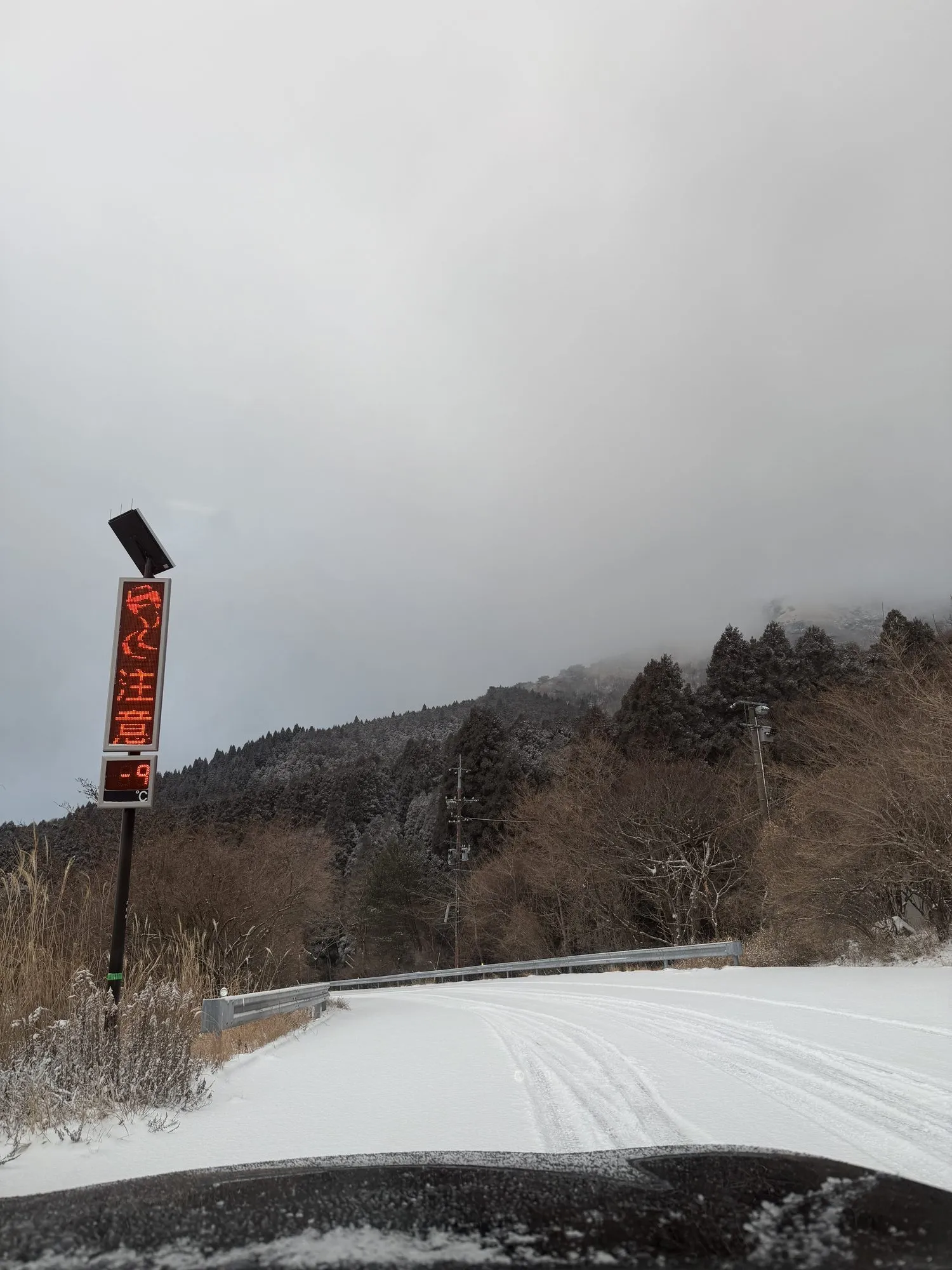
凍結注意 — “caution, ice”. The reading underneath is −9°C (16°F). These signs are not decorative, and this is the road up to the ski area.
This is the section we would most like visitors to read, because getting it wrong here is dangerous rather than merely inconvenient.
Snow falls from early December to mid-March, and it settles properly every single year. This is not a “dusting in some winters” situation. This is a mountain area at altitude and it behaves like one.
Snow tyres are an optional extra — you have to ask for them
In Japan, winter tyres are not fitted as standard. They are a paid option you select when booking, and if you do not select one, you will be handed a car on summer tyres in January.
Request them at the time of booking, not at the counter. Supply is limited in season and there is no guarantee they can fit them on the day.
If you are comparing prices for a winter trip, treat snow tyres as part of the price rather than an upgrade to think about later.
Ice forms on days when it has not snowed
This catches people out more than snowfall does. Clear sky, dry-looking surface, and the road is frozen — particularly in the morning, in shade, and on bridges.
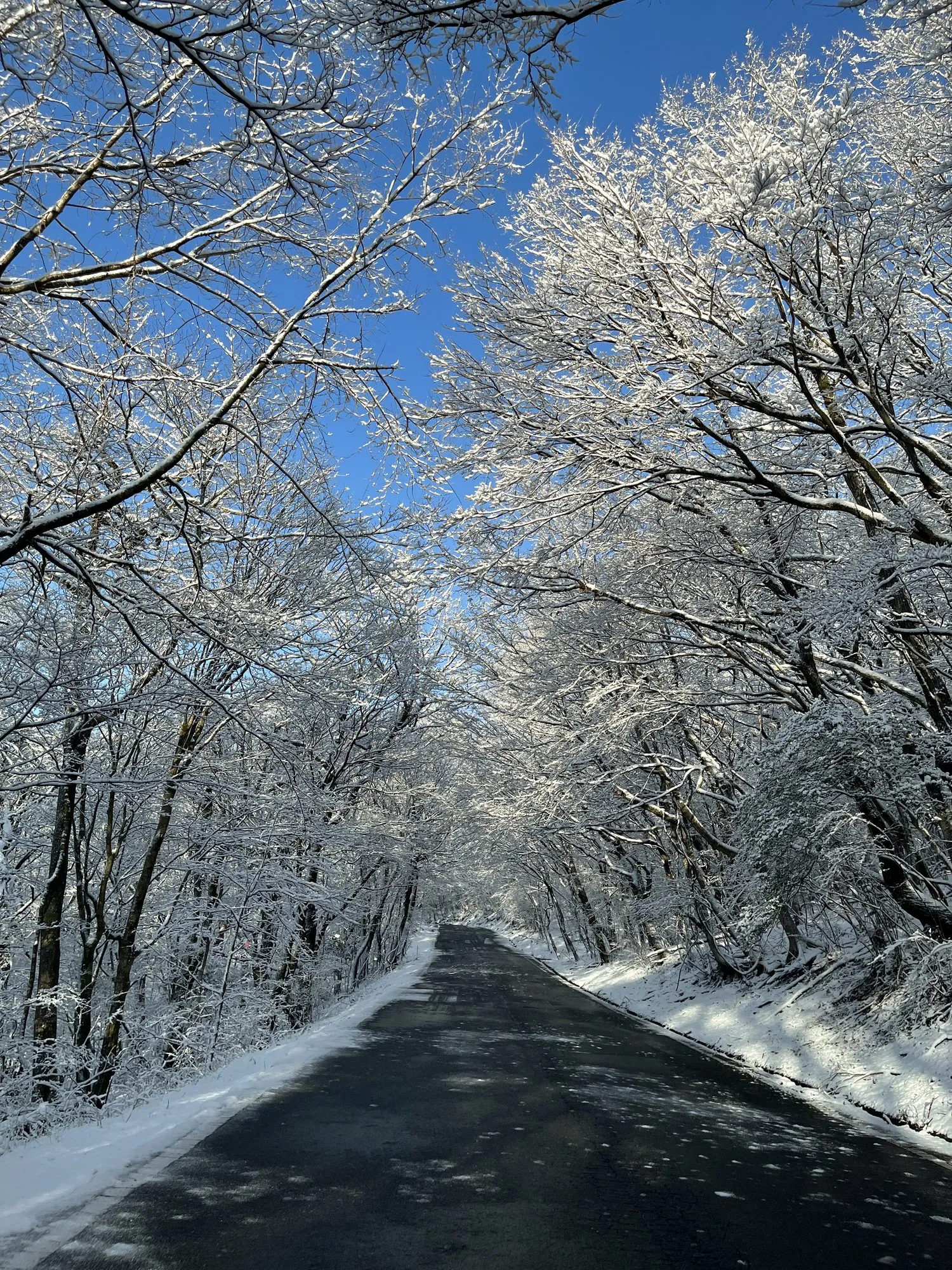
A good day. The trees are stunning, the sky is blue, and the shaded sections of that surface are still frozen.
Every winter there are accidents on the larger curves and descents near the Kuju ski area. Every winter, without exception.
If you are coming to ski, take the northern route
This one matters, and almost nobody gets it right on their own.
The ski area at Kuju sits close to us as the crow flies, but the direct road up from the Kurokawa side is narrow, and it ices badly. It is not the road to be learning Japanese mountain driving on in January.
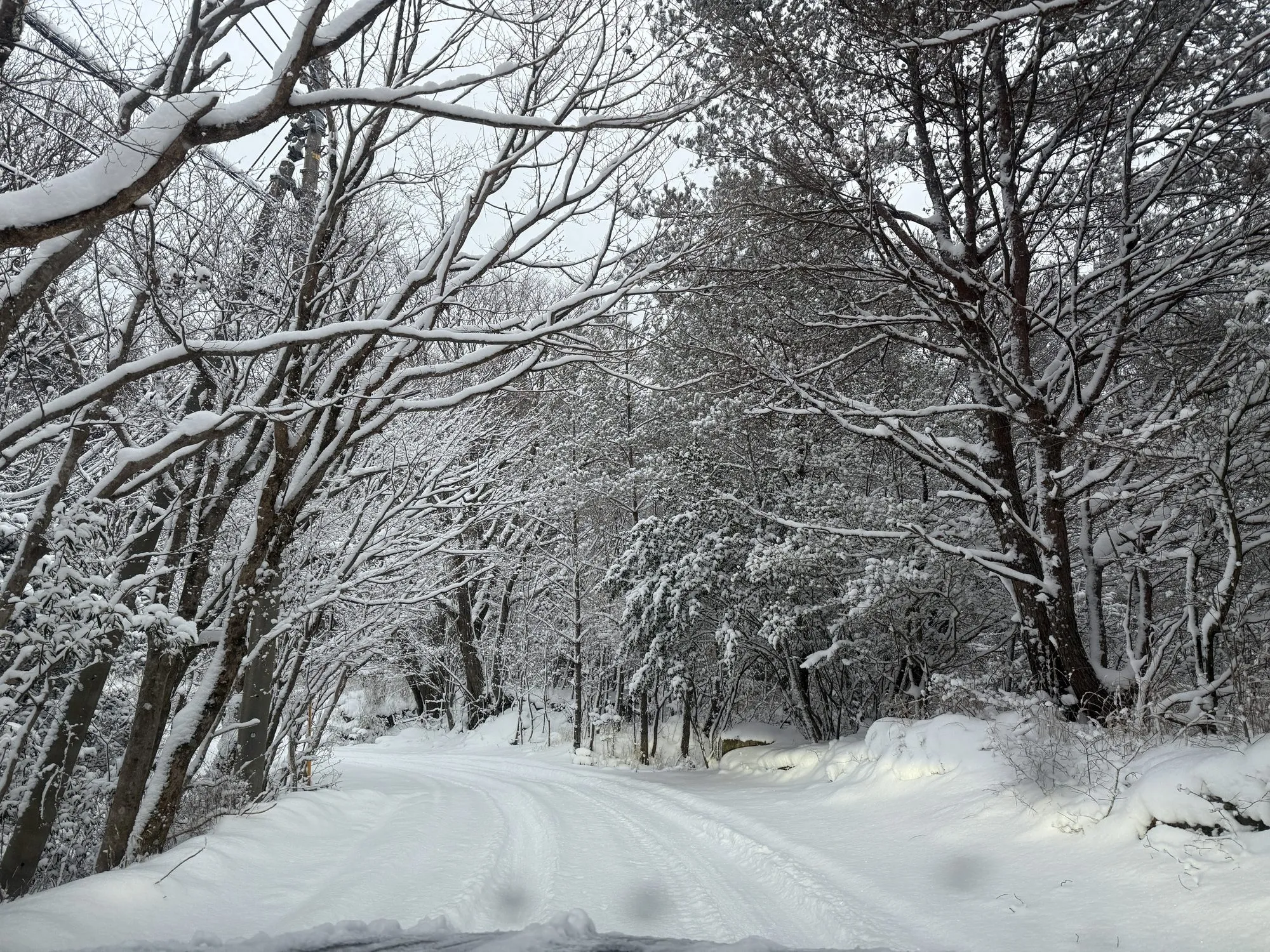
The short way up, in winter. Two tyre tracks and nowhere to pass.
The route we point winter guests to instead comes in from the north: expressway from Fukuoka IC to Kokonoe IC, then up the Shikisai Road. It carries real traffic volume, which means it gets properly cleared of snow — and a ploughed road with other cars on it is worth far more in winter than a shorter line on a map.
So if skiing is part of the trip and onsen is the other part, fly into Fukuoka. It is the one situation where Fukuoka clearly beats Kumamoto.
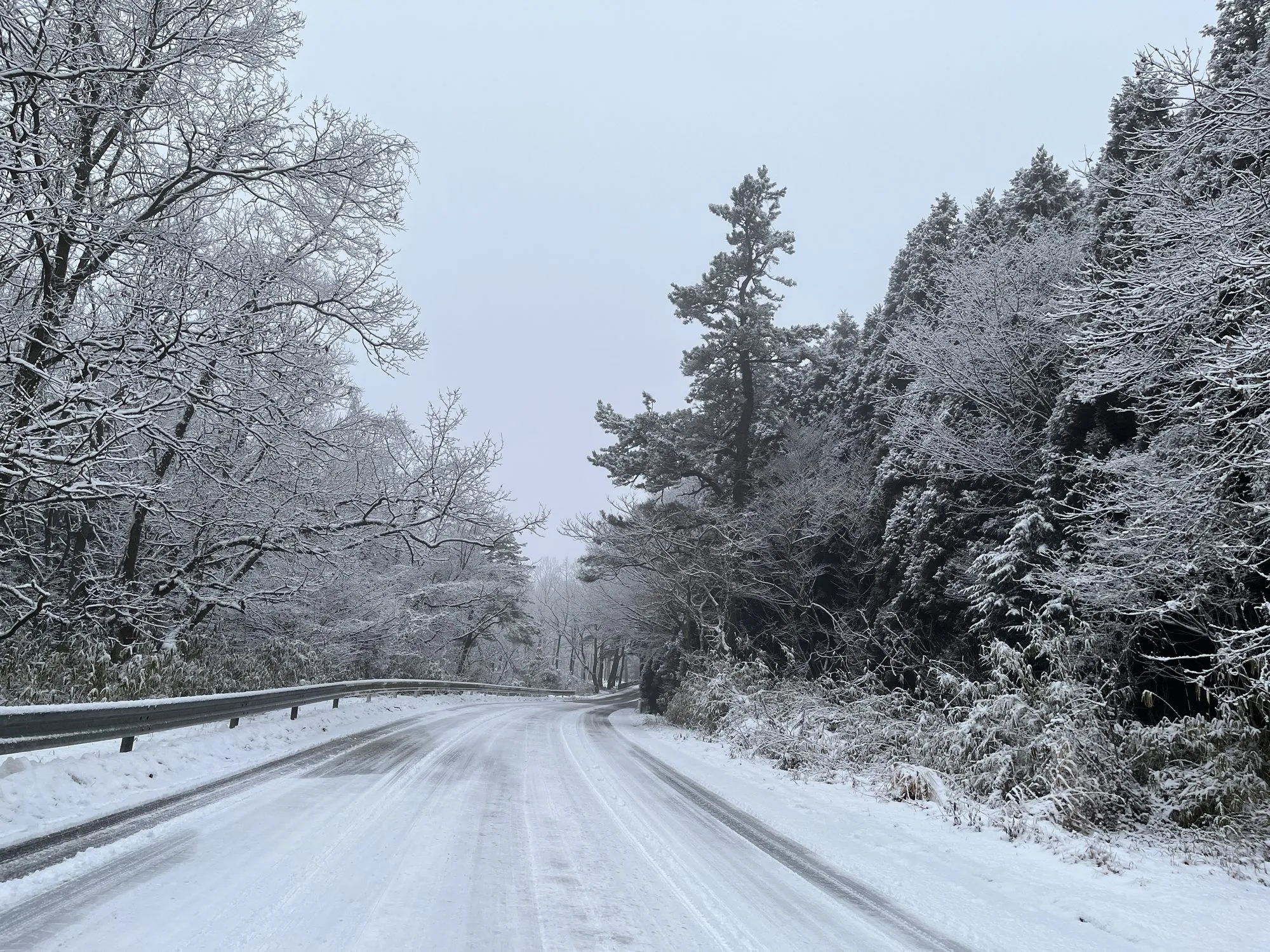
A road that carries traffic. Still snow, but compacted, tracked, and predictable — which is the whole point.
Even on that route, the slopes immediately around the ski area ice over. Snow tyres, again.
What we tell guests, plainly
If it snows heavily, you may not be able to reach us at all. We say this before people book, because we would rather lose a booking than have someone attempt a mountain road they should not attempt.
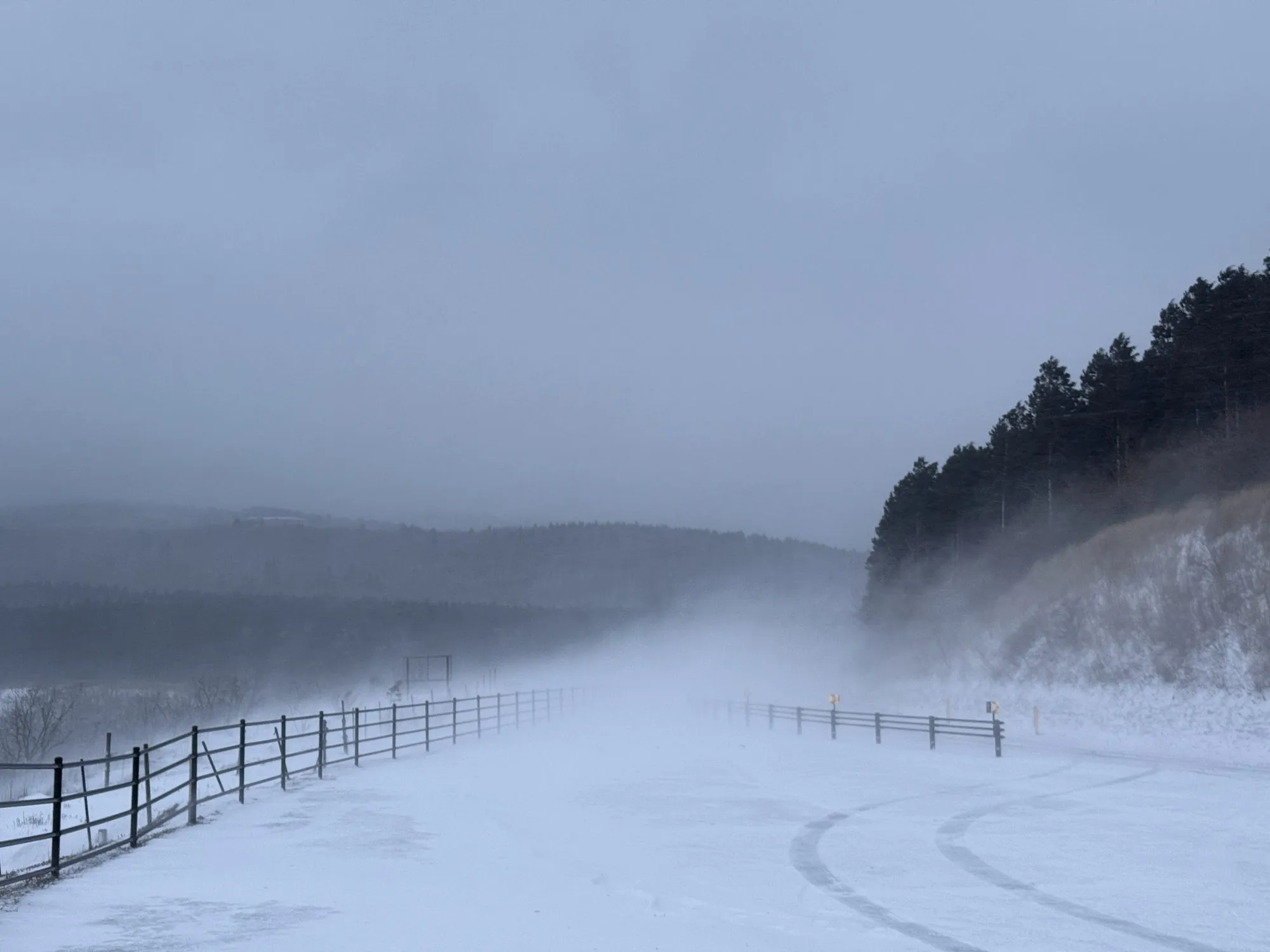
This can arrive within an hour. There is no version of this where pressing on is the right call.
Build slack into a winter itinerary, and do not schedule anything you cannot abandon.
Where to rent: Kumamoto or Fukuoka?
Most visitors fly into one of the two, and the choice matters more than the map suggests.
Kumamoto Airport (KMJ) — about an hour and a quarter
The route runs through Kikuyo, Ozu and Aso before dropping into Minamioguni. It is the easier drive and the one we recommend.
One practical detail: Kikuyo and Ozu are lined with restaurants and fast food. Between Aso and Minamioguni there is almost nothing. If anyone in the car needs feeding, do it before you leave Aso.
The route also passes several of the best stops in the region, so the transfer can be the day itself. More on that below.
Fukuoka Airport (FUK) — about an hour and three quarters
You take the expressway toward Oita, exit at Hita, then follow the Hita–Oguni road down into Minamioguni.
That is the figure on paper, and it holds on a clear run. In practice, budget more: getting clear of Fukuoka Airport takes longer than the map thinks, and it is a tolled route.
So which?
The gap is smaller than most people assume — around half an hour — so this is not really a decision about time.
Fly into Kumamoto if you have the choice. Not because of the half hour, but because the Kumamoto route is toll-free, easier driving, and passes Aso Shrine and Daikanbo on the way, which means the transfer can be the day rather than a cost of it.
Fly into Fukuoka if that is where your flight lands — many international routes into Kyushu land there and nowhere else, and half an hour is not a reason to add a connection. It is a good drive with a proper expressway for most of it.
And fly into Fukuoka if you are coming to ski, for the reasons set out above.
You can see what is available on your dates at Kumamoto Airport or at Fukuoka Airport. Book earlier than you would at home — in autumn foliage season and over New Year, cars and snow tyres both run out.
Your licence: get this right before you fly
Trips end at the rental counter over this, and no amount of explaining changes it. Without the correct document, you do not get a car.
If your country signed the 1949 Geneva Convention
You need an International Driving Permit (IDP) issued under that convention. This covers most visitors — the US, UK, Canada, Australia, New Zealand and many others.
Three things matter:
- Get it at home before you fly. You cannot obtain one inside Japan.
- Carry all three documents whenever you drive: the IDP, your original licence, and your passport.
- An IDP issued under the 1968 Vienna Convention is not valid here. Some countries have signed the Geneva Convention but issue the Vienna-format permit. Check which format yours is before you pay for it.
If your licence is from Switzerland, Germany, France, Belgium, Monaco or Taiwan
An IDP will not work for these six. You need an official Japanese translation of your licence instead, carried together with the original. It is valid for one year from your date of entry.
The translation must come from an authorised issuer — JAF (the Japan Automobile Federation) or your country’s embassy or designated body. One you arrange yourself will not be accepted.
A catch worth knowing in advance: JAF’s online application is only reachable from a network inside Japan. Either arrange it through an authorised service before you travel, or apply after you land and print it at a convenience store.
And the obvious one
We drive on the left. If that is new to you, the roads out of both airports are wide and clearly signed, which makes them a reasonable place to adjust. The narrow parts come later.
Insurance, the deductible, and the charge nobody warns you about
Most Japan guides skip this. It is the most expensive thing you can misunderstand about renting a car here, and on winter roads it deserves ten minutes of your attention.
What is already included
Japanese rental cars come with basic insurance as standard. You do not need to buy that separately.
What is not included, part one: the deductible
Standard cover leaves you responsible for an excess if you damage the car. That is the number most people expect and budget for.
What is not included, part two: NOC
Here is the one that catches visitors out.
Japanese rental companies charge a Non-Operation Charge (NOC) on top of the deductible. It is not insurance and it is not the repair bill — it is a fee for the income the company loses while the car sits in a workshop.
You pay it even when you are fully insured for the damage itself. Even for a scraped bumper in a car park. Guests have discovered this at the return desk, and it is not how anyone wants a trip to end.
Your two options
Option A — the rental company’s package. Every Japanese company sells an optional top-up at the counter, usually with 安心 (anshin, “peace of mind”) in the name, which waives both the deductible and the NOC on the spot. Nothing to claim, nothing to pay, no forms. It costs more.
Option B — DiscoverCars’ Full Coverage. Added when you book, it covers the deductible plus items basic waivers often exclude — tyres, wheels, windows, mirrors, lights, bodywork, roof, undercarriage — and it explicitly covers loss-of-use charges, which is what NOC is. The limit runs up to €5,000.
Understand how it works before you rely on it. It is a reimbursement policy, not a waiver:
- The rental company cannot see it in their system, and will offer you their own product anyway
- You still leave a credit card deposit at the desk
- If something happens, you pay the Japanese company first, then claim
- You file within 90 days of drop-off, and the review takes up to 28 days, extendable by another 28
So: wider cover for less money, at the cost of paying out of pocket in Japan and waiting for the refund afterwards.
What we would actually do
Take the snow tyres regardless of which you choose. Both options exclude damage arising from gross negligence or from breaching your rental agreement — and a summer-tyred car on a Kyushu mountain road in January is not a position you want to be arguing from during a claim.
Beyond that it is a real choice. If you want zero friction and no paperwork, take the counter package. If you would rather have broader cover for less and can absorb a temporary charge on your card, Full Coverage does more for the money.
What we would not do is decline both. The roads are narrow, the parking is tight, and in winter the surfaces are genuinely slick.
Driving here, for real
The roads
National routes and main roads are wide and easy. Mountain roads are not. Some are single-track in practice, with stretches where two cars cannot pass and one of you reverses to a wider spot. The road from our lodge up to the ski area is one of these.
It is not difficult driving. It is simply not what the map implies, so allow more time than the estimate says.
There is almost no street lighting
Off the main roads at night it is properly dark. Combined with narrow lanes, you will want to be driving slower than feels necessary.
Animals, and this is not a novelty warning
Deer, wild boar, tanuki and weasels all come out of the treeline without warning. A boar will destroy the front of a car. This is the most likely way for a visitor’s trip here to go badly wrong, and it happens at night.
Slow down after dark. If you see one animal, expect a second.
Mobile signal drops out
There are stretches in the mountains with no coverage at all, which means your navigation stops working exactly where you most need it. Download offline maps for the area before you set off. Do not rely on a live connection.
Fuel
Simple, and worth planning around.
Fill up in Aso or Ozu. Do not arrive in the Kurokawa area on a quarter tank expecting to sort it out later.
- Stations around Kurokawa mostly close around 18:00, with no late-night option
- Rural stations here are almost all full-service — an attendant fills the car, so you only need to say the fuel type
- In the cities you will mostly find self-service, and it is cheaper
If you are filling it yourself, nozzles are colour-coded:
| Colour | Japanese | What it is |
|---|---|---|
| Red | レギュラー | Regular petrol — most rental cars |
| Yellow | ハイオク | High-octane, for premium vehicles |
| Green | 軽油 | Diesel |
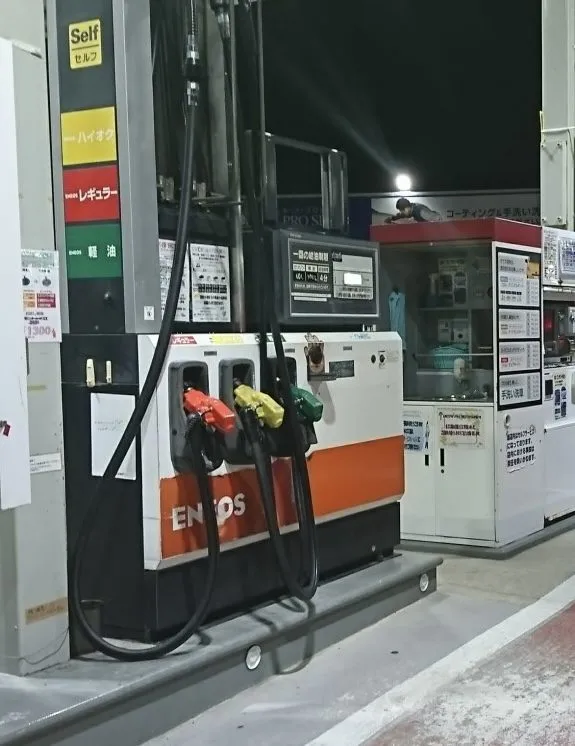
Red, yellow, green — left to right, and the labels on the column match. Worth a photo on your phone before you need it.
The green one deserves its own warning. 軽油 contains the character 軽, meaning “light”, and visitors reasonably but wrongly read it as a lighter grade of petrol. It is diesel. Putting it in a petrol car is an expensive mistake, and no policy covers it.
Parking
Better news here — mostly free and mostly easy.
- Kurokawa Onsen has three free car parks serving the ryokan district
- Daikanbo and most major viewpoints are free
- Aso Shrine and Kusasenri charge
The exception is weekends, when Kurokawa’s car parks do fill. In autumn foliage season they fill early. Arrive before mid-morning or plan for a wait.
A route that works
If you land at Kumamoto Airport, do not treat the drive as a transfer. Done properly, it is the best day of the trip.
Aso Shrine sits close to the main route and makes a natural first stop.
Daikanbo is the view of the caldera — the one that explains the geography better than any map can. Free to park, and on the way.
Mount Aso and Kusasenri are a detour rather than a stop, and worth the extra time if you have it.
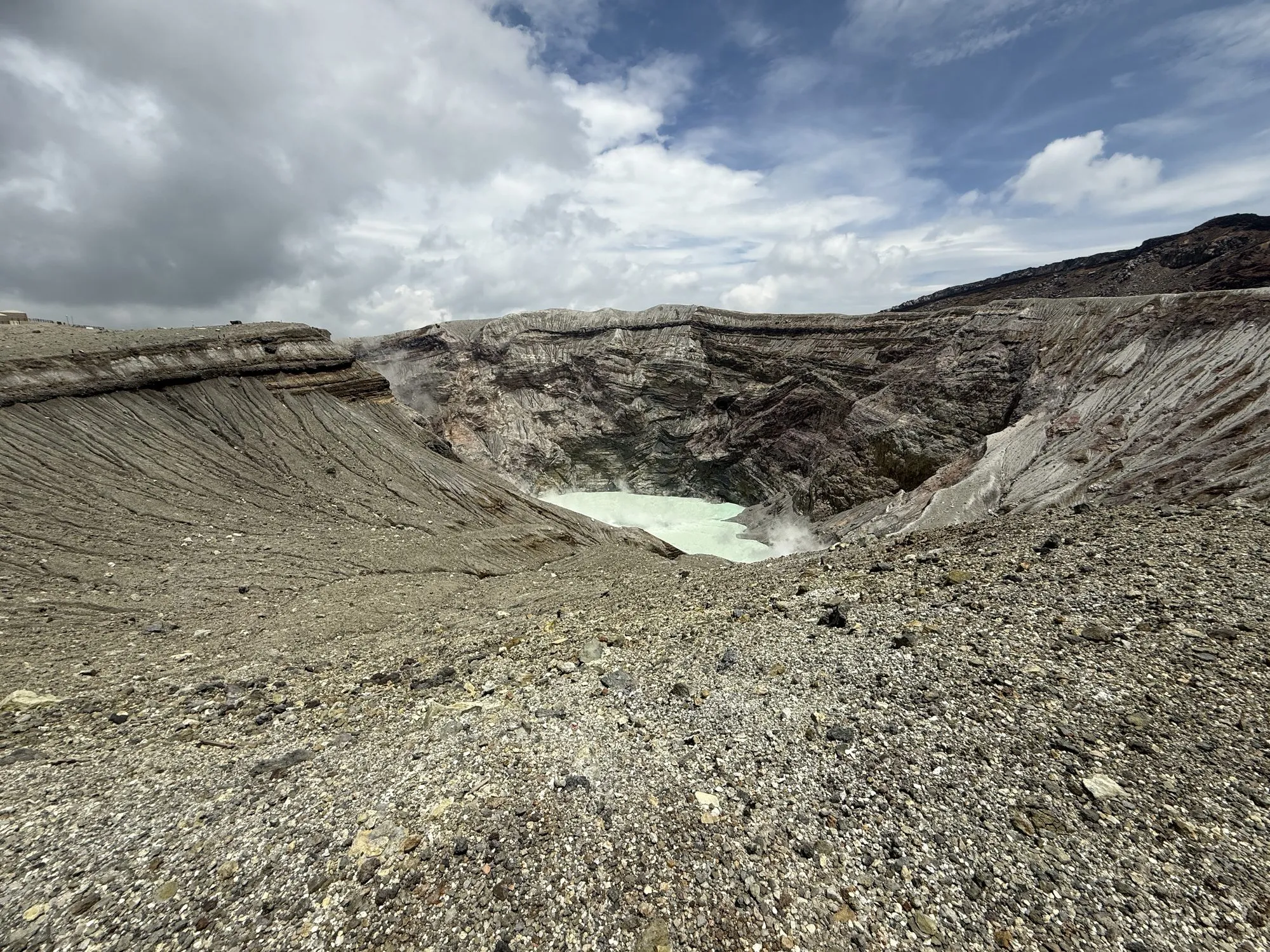
Nakadake crater. Check the volcanic activity status before you commit — access closes at short notice, and it is a long detour to be turned around at the barrier.
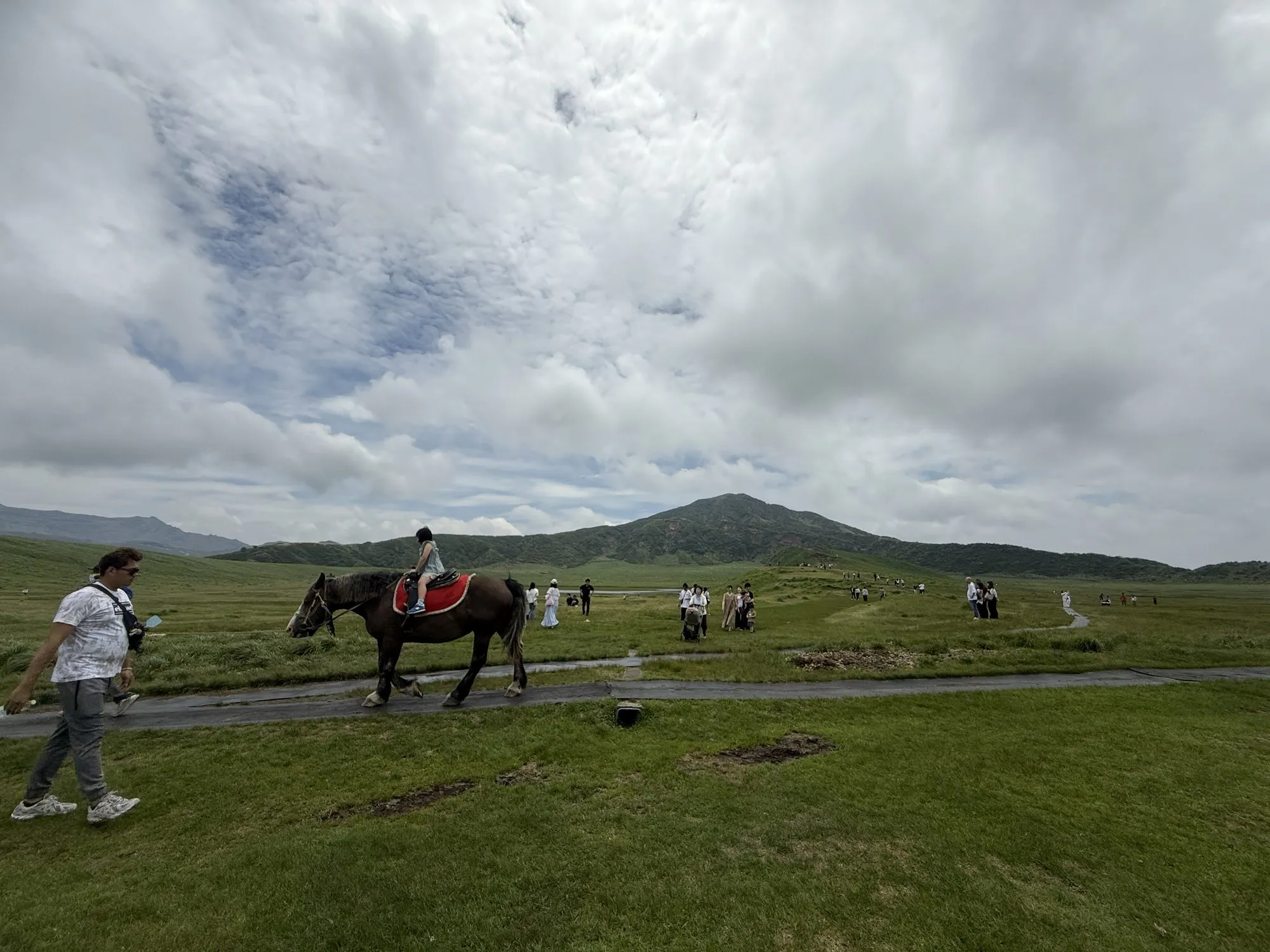
Kusasenri, in summer. Parking here is one of the few places in the area that charges.
Closer to us, Nabegataki Falls — where you can walk behind the water — and Oshitoishi no Oka, a hilltop of standing stones looking out across the whole area, are both within easy reach. Neither is reachable without a car.
One booking note: Nabegataki requires a reservation. Outside peak season and the long holiday weeks you can usually book the same day, but do not simply drive up and expect to walk in.
Arrive in Kurokawa in the late afternoon, in time for the baths before dinner.
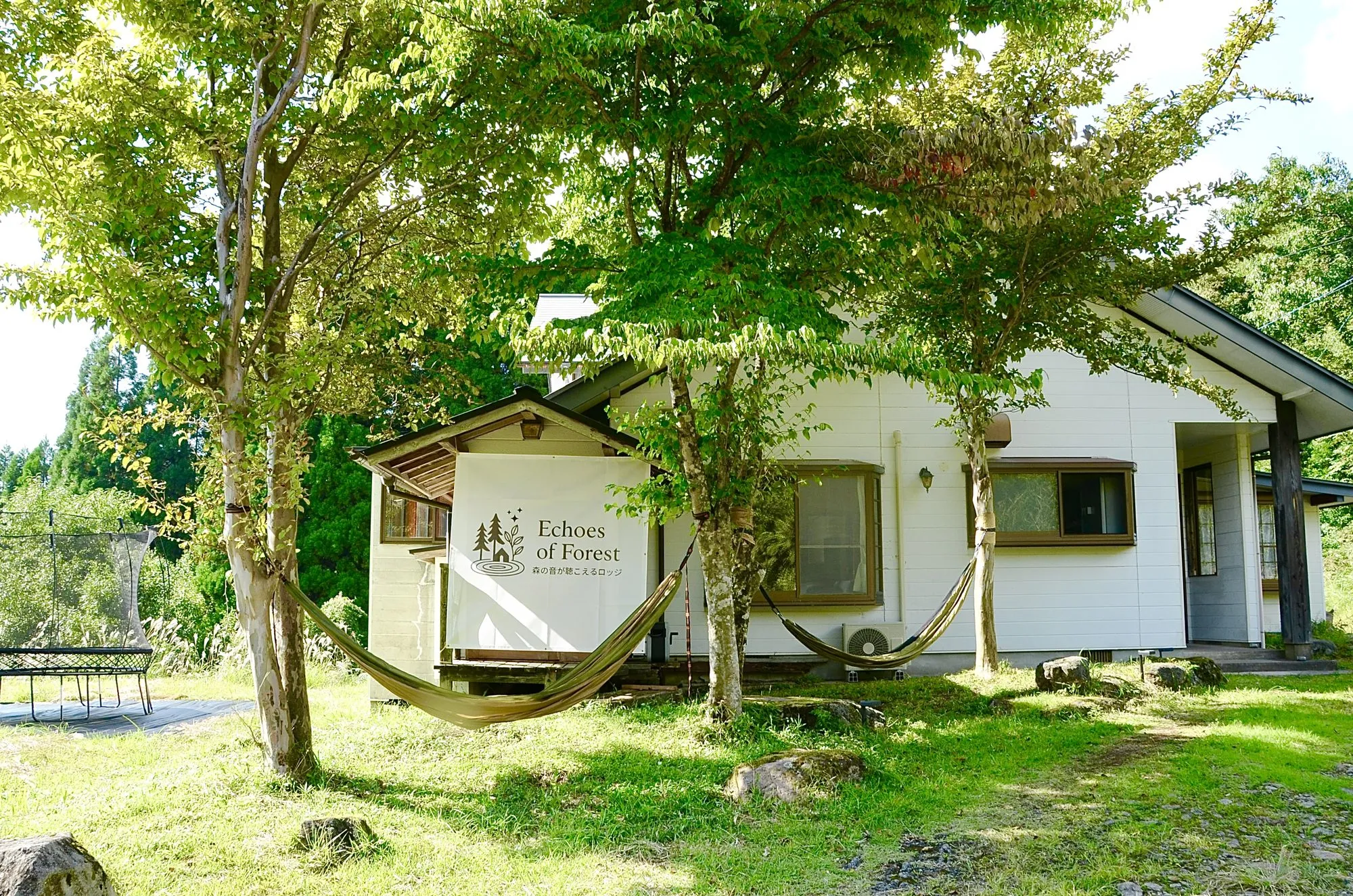
Where we are
We rent the whole lodge to one group per day — four bedrooms, up to ten guests, about ten minutes by car from Kurokawa Onsen. Everything on this page is the advice we give our own guests before they arrive.